
Many people with OCD spend years trying to manage symptoms on their own, without a clear understanding of what treatment actually involves.
You may have heard that therapy helps, that medication can be useful, or that exposure work is “hard,” but the details often feel vague or intimidating.
That uncertainty can keep people stuck. Without a clear picture of how OCD is treated, it’s easy to delay care, second-guess options, or assume treatment will be overwhelming or unrealistic for daily life. In the meantime, OCD continues to take up time, energy, and mental space.
This guide explains how OCD is treated today, based on established clinical approaches used in real-world settings.
We’ll walk through the most effective therapies, how treatment typically unfolds, what the process feels like, and how people often begin care in manageable ways.
ERP Therapy
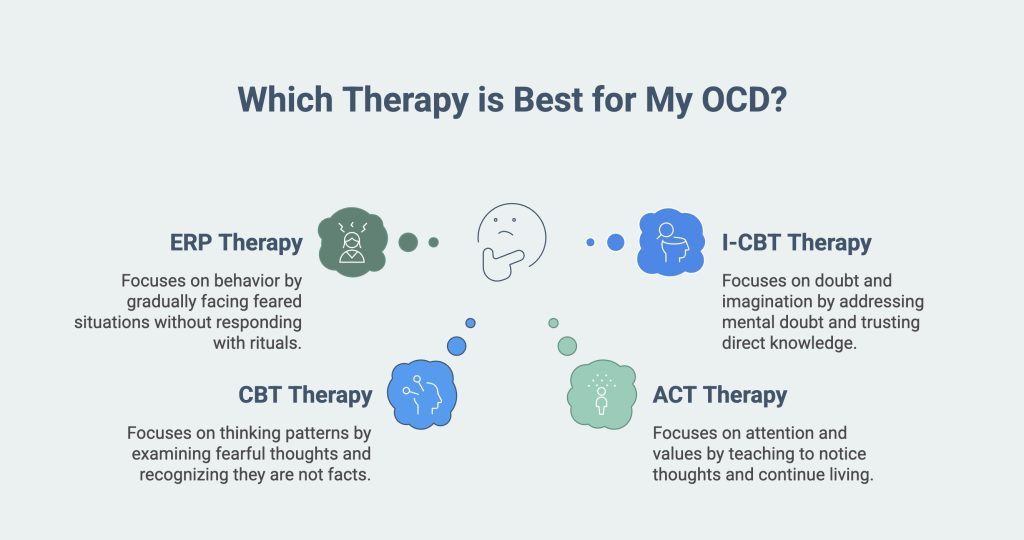
Exposure and Response Prevention (ERP) is the most widely used therapy for OCD. ERP focuses on behavior. It works by gradually facing feared thoughts or situations while learning not to respond with rituals, allowing anxiety to rise and fall on its own, according to the International OCD Foundation
Treatment usually follows a step-by-step plan, starting with less distressing triggers and slowly moving toward harder ones.
For example, someone with checking OCD might begin by imagining leaving the house without checking, then later practice doing so in real life with support.
ERP can be done weekly, through teletherapy, or in short intensive programs, depending on schedule and needs. Anxiety often increases early on, then becomes easier to tolerate over time.
With consistency, many people experience meaningful symptom reduction and greater control over daily life.
CBT Therapy

Cognitive Behavioral Therapy (CBT) is another common treatment for OCD. CBT focuses on thinking patterns. It helps you slow down and examine fearful or rigid thoughts instead of reacting to them automatically.
Over time, you learn that thoughts are not the same as facts. As this becomes clearer, the thoughts tend to feel less powerful and less likely to drive your behavior.
CBT is usually done in weekly sessions over several months. As skills build, obsessive thoughts often feel less convincing and less likely to dictate decisions or behavior.
ACT Therapy

Acceptance and Commitment Therapy (ACT) is used to treat OCD by changing your relationship with thoughts. ACT focuses on attention and values.
Instead of trying to fix, analyze, or push thoughts away, ACT teaches you to notice them and keep going with your day anyway. The focus is on living your life, not managing every thought.
Discomfort may still show up at times, but it no longer decides what you do. Over time, many people notice that thoughts feel less important and take up less space.
ACT is often done in weekly sessions and fits well for people balancing work, relationships, and family life. Many people find they spend less time managing OCD and more time doing what matters to them.
I-CBT Therapy

Inference-Based CBT (I-CBT) is designed for people whose OCD mainly shows up as mental doubt. I-CBT focuses on doubt and imagination.
This approach focuses on how OCD pulls you into imagined scenarios instead of what’s actually happening. Therapy helps you stop treating “what if” thoughts as warnings and start trusting what you directly know.
I-CBT is typically done in weekly sessions and can feel especially approachable for people whose OCD lives mostly in their thoughts rather than in visible behaviors.
Other Treatment Options

Medication for OCD
Medications called SSRIs are commonly used for OCD. They help regulate serotonin, a brain chemical involved in anxiety and repetitive thinking.
These medications often take several weeks to help. Some people notice changes after a few weeks, while fuller benefits may take a couple of months. Medication doesn’t erase OCD, but it can lower its intensity enough to make therapy easier. It works best when combined with therapy, not used alone.
Transcranial Magnetic Stimulation (TMS)
TMS is a noninvasive treatment that uses magnetic pulses to stimulate specific brain areas involved in OCD. By targeting these areas, TMS helps the brain become less rigid, making obsessive thought patterns easier to interrupt.
For some, urges feel less intense or easier to pause before acting on them. TMS does not involve surgery and is often used alongside therapy, especially when symptoms haven’t improved enough with therapy alone.
Deep Brain Stimulation (DBS)
DBS is reserved for severe, treatment-resistant OCD. It involves implanting small electrodes in specific brain areas linked to obsessive and repetitive thinking.
The electrodes send steady signals that help calm overactive brain circuits. This can reduce the intensity and frequency of obsessions and compulsions when other treatments have not helped. DBS is carefully managed under specialized medical care and considered only after thorough evaluation.
Building Your OCD Treatment Plan
Once you understand therapy options, the next step is choosing support that fits your life. OCD treatment works best when it’s personalized. Your symptoms, schedule, and capacity all matter, and there’s no single right plan.
Most people start by working with a therapist who understands OCD. Early sessions focus on how OCD shows up for you and which approach makes sense to begin with. Plans can change over time based on what helps.
Additional support can also be useful. OCD support groups help reduce isolation and offer encouragement from others with similar experiences. Online resources can help you learn about treatment options and find qualified providers.
If you’re unsure where to start, a therapist can help you sort through options and build a plan that feels manageable and supported.
Making Treatment Feel Possible

How is OCD treated? Most treatment focuses on changing how you respond to thoughts and urges, not trying to eliminate them. With the right therapy and support, many people find that OCD takes up less time and has less control over daily life.
You don’t need a perfect plan to start. Working with a therapist can help you choose an approach that fits your needs and adjust it over time.
If you’re ready to take the next step, reach out today to get support and begin care at a pace that feels manageable.
Frequently Asked Questions
How Is OCD Usually Treated?
OCD is most often treated with specialized therapy that focuses on changing how someone responds to obsessive thoughts. Approaches like ERP, CBT, ACT, or I-CBT help reduce compulsions and mental loops. Medication may be added to lower symptom intensity, but therapy is usually the foundation.
Does OCD Treatment Mean Getting Rid Of Thoughts?
No. OCD treatment does not aim to eliminate thoughts. Instead, therapy helps people respond differently to them. Over time, thoughts tend to feel less urgent and less convincing, reducing how much control they have over behavior and daily decisions.
How Long Does OCD Treatment Usually Take?
Treatment length varies based on age, symptoms, and consistency. Many people notice improvement within several months of regular therapy. Early sessions focus on understanding patterns, followed by skill practice. Progress is gradual and often continues as skills are used outside sessions.
Can OCD Be Treated Without Medication?
Yes. Many people treat OCD successfully with therapy alone, especially approaches like ERP or CBT. Medication may be added when symptoms feel overwhelming or slow to improve. Decisions about medication depend on individual needs and guidance from a qualified healthcare provider.
How Do I Know Which OCD Therapy Is Right For Me?
The best therapy depends on how OCD shows up for you. Some approaches focus on behaviors, others on thinking patterns or mental doubt. A therapist experienced with OCD can help assess symptoms and recommend a starting approach that fits age, goals, and daily life.