
Is this just perfectionism, or could it be something more? It can be hard to tell when both look similar at first.
When it comes to OCD and perfectionism, the difference is not about how high your standards are. It is about what is driving your behavior underneath.
What matters most is how your actions feel. You may want things done well, but when it starts to feel repetitive or urgent, the pattern may be shifting.
Noticing that shift can help you respond differently. Here’s how these patterns differ.
How perfectionism and OCD are different

Perfectionism focuses on achieving high standards, while OCD is driven by anxiety and the need to reduce distress.
Perfectionism is usually linked to performance, productivity, or avoiding mistakes. It is about doing something well or meeting expectations, and while it can feel frustrating, there is still a sense of choice and flexibility.
Obsessive-Compulsive Disorder (OCD) is driven by unwanted thoughts and the need to reduce discomfort. Actions are repeated not to improve outcomes, but to feel safe or certain, even when the threat is not real. It becomes harder to stop, even when you want to, and the behavior can take over time and interfere with daily life.
Signs perfectionism may actually be OCD
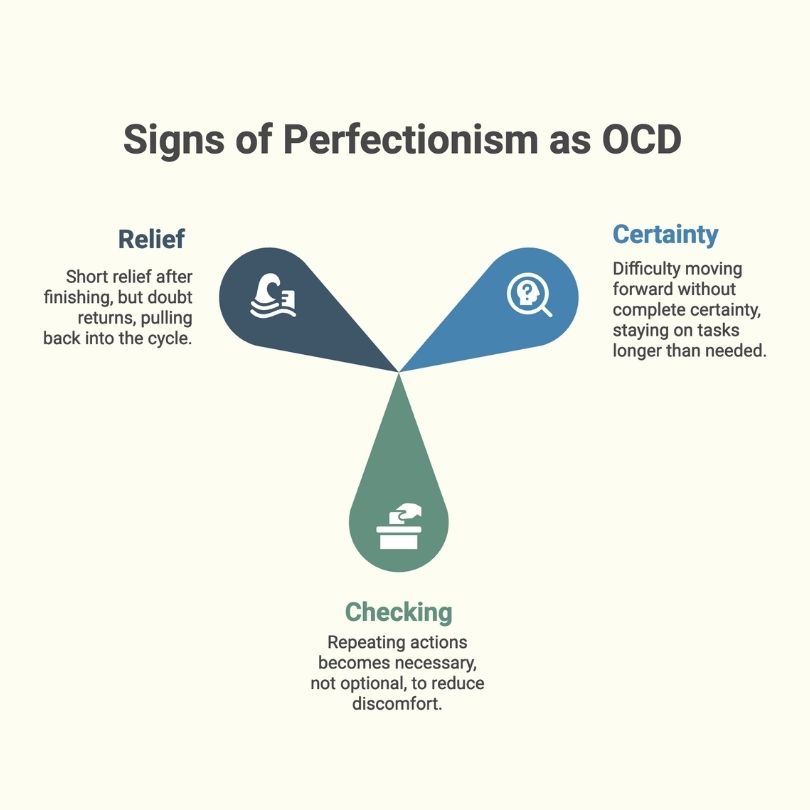
Perfectionism may be OCD when it includes repeated behaviors, strong urges for certainty, and distress that does not resolve.
These patterns often go beyond high standards and start to feel automatic and hard to control.
You need certainty before you can move on
It becomes hard to move forward without feeling completely sure. You may stay on one task or decision longer than needed because it does not feel settled, even when there is no clear reason to keep going.
Checking and redoing take over
Repeating actions starts to feel necessary, not optional. Instead of improving the result, the repetition is used to reduce discomfort, which can turn simple tasks into long, drawn-out processes.
Relief never lasts
Finishing something brings a short sense of relief, but it does not hold. The same doubt returns, which pulls you back into the same cycle instead of allowing you to move on.
How perfectionism OCD affects daily life

Perfectionism OCD affects daily life by increasing time spent on tasks, reducing flexibility, and creating ongoing mental fatigue.
Work and performance
At work, tasks can take much longer than expected because they never feel complete. You may reread emails multiple times, rewrite sentences, or double-check details even after they are already correct.
A task that should take 30 minutes can stretch to 1 or 2 hours, which can lead to missed deadlines, reduced output, or staying late to finish work.
Decisions and routines
Decisions may feel heavier than they should, even when the outcome is low-risk. Daily routines can become fixed, making it harder to adapt or move through tasks efficiently.
Studies show that people with obsessive-compulsive tendencies often find it harder to handle uncertainty, leading to hesitation, avoidance, and inconsistent choices.
Reassurance and mental rituals
A lot of the effort happens internally. You may replay situations, check your thoughts, or look for confirmation to feel settled, which adds to mental fatigue and keeps attention locked on the same concerns.
Treatment that works for perfectionism OCD

Effective treatment for perfectionism OCD works by changing how you respond to thoughts, not by trying to eliminate them. Let’s take a look at what helps reduce the cycle.
Exposure and Response Prevention (ERP)
ERP is a behavioral treatment that breaks the link between anxiety and repeated actions. You face the trigger and do not perform the usual response, which allows the nervous system to settle on its own and reduces the urge to check or redo.
Cognitive Behavioral Therapy (CBT)
CBT is a structured approach that targets patterns between thoughts and behaviors. It helps you identify distorted thinking, such as needing certainty, and replace it with responses that reduce repetition.
Acceptance and Commitment Therapy (ACT)
ACT is a skills-based approach that changes how you relate to thoughts. Instead of trying to control them, you allow them to be present while continuing with your actions, which reduces the need to respond to every thought.
Find an OCD therapist who understands perfectionism
Working with a therapist who understands ocd and perfectionism helps you focus on the patterns that keep the cycle active, not just the thoughts themselves.
Sommer Psychology Group focuses on helping you recognize when perfectionism becomes repetitive and hard to stop, and on building more flexible ways to respond.
When this pattern starts taking up your time or making daily tasks harder, take a clear next step. Get a Free 20-Minute Consultation today.
Frequently asked questions
How can I tell if this is perfectionism or OCD?
Perfectionism is flexible, while OCD feels repetitive and hard to stop. If you feel stuck until something feels completely right and keep repeating actions to reduce discomfort, it may point to OCD rather than just high standards.
When do high standards start looking more like OCD?
High standards start looking like OCD when anxiety drives the behavior instead of performance. When tasks feel impossible to finish without repeated checking or certainty, and the discomfort does not settle, the pattern shifts beyond normal perfectionism.
What does perfectionism OCD look like in daily life?
Perfectionism OCD often shows up as tasks taking longer than expected due to repeated corrections or hesitation. It can also involve difficulty making decisions, rigid routines, and mental exhaustion from constantly trying to get things to feel right.
What rituals or compulsions are common with perfectionism OCD?
Common compulsions include rechecking work, rewriting tasks, and mentally reviewing decisions to feel certain. These actions are not about improving quality, but about reducing discomfort, which keeps the cycle active and difficult to break.
What kind of therapy helps with perfectionism OCD?
Evidence-based therapies focus on reducing the need to respond to thoughts rather than removing them. Approaches like ERP, CBT, and ACT help retrain how you respond to discomfort and reduce the urge to check or redo tasks.