
ADHD and OCD together in adults can create overlapping symptoms that are difficult to separate. Challenges with attention, follow-through, and organization may occur alongside rigid thinking, mental loops, or repetitive behaviors. These patterns can interfere with work, relationships, and everyday functioning.
Because the symptoms pull in different directions, they are often misunderstood or attributed to anxiety, personality traits, or lack of effort. This can delay accurate identification and appropriate treatment.
Understanding how ADHD and OCD interact helps clarify why symptoms feel so conflicting and supports more effective care. In clinical work with adults, these conditions frequently appear together.
This guide explains how they overlap, how they differ, and how treatment is typically approached when both are present.
How Common Is ADHD and OCD Together in Adults?

ADHD and OCD together in adults occur more often than is typically recognized in general mental health settings. Research shows that approximately 25–33% of individuals with OCD also meet criteria for ADHD, while about 8–11% of individuals with ADHD meet criteria for OCD.
Part of the challenge is that symptoms can mask each other. Attention difficulties may be attributed to anxiety or obsessive thinking, while compulsive behaviors may be overlooked when ADHD is already diagnosed. This can delay accurate identification of both conditions.
ADHD also persists into adulthood in roughly 60% of childhood cases, increasing the likelihood that both conditions may be present at the same time. Recognizing how often these conditions co-occur helps explain why symptoms may feel more intense or harder to manage when only one diagnosis is addressed.
How ADHD and OCD Symptoms Can Overlap
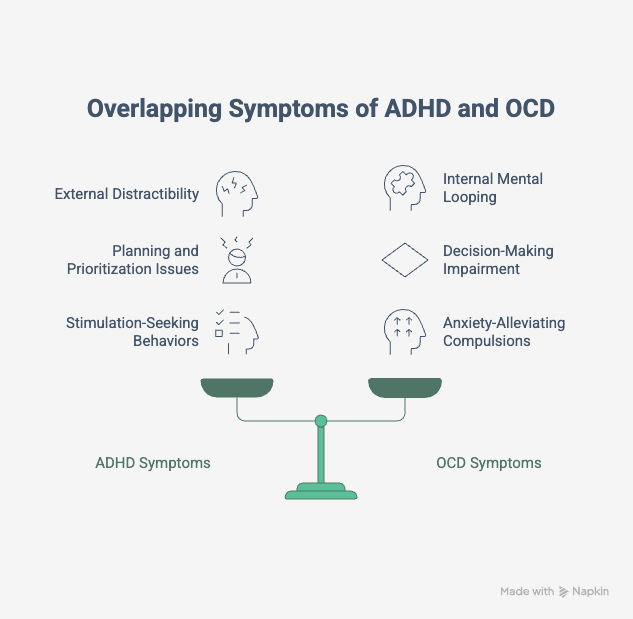
When ADHD and OCD occur together, symptoms often blend in ways that make them difficult to identify clearly. This overlap can interfere with daily functioning and complicate diagnosis.
How Attention Difficulties Show Up
In adults with both conditions, inattention does not always stem from distractibility alone. Obsessive or repetitive thoughts can take up mental space, making it hard to focus on tasks at hand.
The result may look like ADHD-related inattention, even though the underlying driver is OCD-related mental looping.
Executive Function Challenges
Both ADHD and OCD affect executive functioning, but in different ways.
ADHD can impact planning, prioritizing, and task initiation.
OCD can slow decision-making due to overthinking, doubt, or the need for certainty.
When combined, these patterns can lead to hesitation, task paralysis, or excessive mental effort without completion.
Repetitive Behaviors With Different Purposes
Some behaviors may appear similar on the surface while serving different functions.
In ADHD, repetitive actions may relate to restlessness or stimulation.
In OCD, compulsions are performed to reduce anxiety or prevent feared outcomes.
When both are present, it can be difficult to tell which process is driving the behavior without careful assessment.
Emotional and Daily Life Impact
The overlap often affects work, relationships, and routines. Tasks may feel overwhelming, schedules inconsistent, and expectations difficult to meet. Interpersonal strain can arise when impulsivity, forgetfulness, or rigid rules conflict.
These challenges reflect underlying neurodevelopmental patterns, not lack of effort or motivation.
Brain Science Behind ADHD and OCD Together in Adults

ADHD and OCD affect the brain in different ways, but they also impact some of the same systems that control focus, behavior, and self-regulation. When both conditions are present, these shared systems can become overwhelmed, making symptoms feel stronger and harder to sort out.
- ADHD is linked to differences in brain networks involved in attention and self-control. This can make it harder to stay focused, start tasks, and pause before acting, even when you care and are trying hard.
- OCD shows a different pattern. It is linked to higher activity in brain areas involved in detecting danger, noticing mistakes, and forming habits. This can lead to repetitive thoughts, mental loops, and urges to repeat behaviors.
Even though ADHD and OCD are different, both affect executive functioning. This includes the brain’s ability to plan, organize, shift focus, and make decisions. When these skills are strained, daily tasks can feel much harder.
Common challenges include:
- Difficulty starting or finishing tasks
- Trouble letting go of thoughts or switching focus
- Feeling stuck or rigid when making decisions
ADHD and OCD also involve different brain chemicals, which help explain why treatments are not the same.
- ADHD mainly involves dopamine, which affects focus, motivation, and reward
- OCD is more closely linked to serotonin, which affects anxiety and mood
Real-Life Struggles When ADHD and OCD Co-Occur

When ADHD and OCD occur together, their combined effects often show up across daily life, making routines harder to manage and symptoms feel more intense.
- At work or school: Attention difficulties can collide with rigid thinking or mental loops. Tasks may be slow to start or finish, deadlines may be missed, and shifting between responsibilities can feel overwhelming.
- With daily tasks: Planning, organizing, and completing activities may take more effort. Decisions can feel stuck, especially when things need to feel “just right” before moving forward, leading to mental fatigue.
- In relationships: ADHD-related forgetfulness or impulsivity may conflict with OCD-related needs for order, certainty, or control. Over time, these differences can create tension, particularly when symptoms are misunderstood as personal choices.
- Emotionally: Living with both conditions can increase stress, shame, or isolation. Anxiety, low mood, trauma-related responses, or hoarding behaviors may also be present and add to the overall burden.
These challenges reflect how overlapping neurological patterns affect daily functioning, not a lack of effort or intention.
Effective Treatments for ADHD and OCD Together in Adults

When ADHD and OCD occur together, treatment works best when both conditions are addressed. Focusing on only one often leaves the other symptoms in place, which can slow progress and increase frustration.
Therapy Approaches
Talk therapy is often a key part of treatment. Cognitive Behavioral Therapy (CBT) is commonly used, and for OCD, Exposure and Response Prevention (ERP) is often included.
When ADHD is also present, therapy may move at a slower pace and use clear structure to support attention and follow-through.
Medication Options
Medication may be helpful for some adults. ADHD is often treated with medications that support focus and impulse control.
OCD is commonly treated with medications that reduce intrusive thoughts and anxiety. When both are present, providers carefully adjust treatment to support balance rather than overstimulation.
Treatment Order
Sometimes one condition needs to be addressed first. If attention problems make it hard to participate in therapy, ADHD support may come first. If obsessive thoughts or compulsions are causing high distress, OCD treatment may be prioritized. This can change over time.
Additional Support
Many adults benefit from extra support alongside therapy. This may include help with organization, routines, emotional regulation, or habit changes.
With coordinated care, symptoms often become more manageable. Working with therapists who understand both ADHD and OCD helps treatment feel clearer and more effective.
Making Sense of ADHD and OCD Together
Living with ADHD and OCD together in adults can feel confusing, especially when symptoms overlap and pull in opposite directions.
Understanding how these conditions interact helps explain why focus, decision-making, routines, and emotional regulation may feel harder than expected, even with strong effort.
With accurate identification and coordinated care, symptoms often become more manageable. Treatment that accounts for both attention-based and obsessive patterns allows therapy and medication to work more effectively, rather than competing with one another.
When you’re ready, talking with a clinician who understands this overlap can help things start to make sense. If you’d like support or have questions, reach out today to begin the conversation.
Frequently Asked Questions
Can ADHD and OCD occur together in adults?
Yes. ADHD and OCD can occur together in adults, and this overlap is more common than many realize. Shared symptoms like inattention, mental loops, and difficulty completing tasks can mask each condition. A careful clinical assessment helps clarify how both patterns are present and interacting.
How can I tell if my attention issues are ADHD or OCD-related?
Attention problems can come from different sources. ADHD-related inattention often involves distractibility or difficulty sustaining focus, while OCD-related attention issues are driven by intrusive thoughts or mental checking. A clinician looks at why focus is disrupted, not just how it appears day to day.
Does having both ADHD and OCD make symptoms worse?
Having both conditions can intensify symptoms because they affect overlapping brain systems. Obsessive thinking can overwhelm attention, while ADHD-related impulsivity can increase distress around control or mistakes. This combination often makes daily tasks feel more exhausting, even with significant effort.
What does treatment look like when ADHD and OCD are both present?
Treatment usually addresses both conditions together. Therapy may combine structured approaches for attention with techniques that reduce obsessive thinking. Medication decisions are individualized and carefully balanced. When care accounts for both patterns, treatment often feels clearer and more effective over time.
Can ADHD and OCD be misdiagnosed as anxiety?
Yes. Many adults are first told they have anxiety because symptoms overlap. Mental restlessness, worry, and difficulty focusing can fit multiple conditions. When ADHD and OCD are both present, a more detailed evaluation helps avoid missed diagnoses and guides more appropriate, targeted support.