
Behavioral therapy for anxiety works by changing the behaviors and responses that reinforce anxiety. Instead of trying to remove anxious thoughts, the focus is on changing how you respond to them.
Anxiety often follows repeated cycles that influence behavior and decision-making, making reactions feel automatic over time. Through structured strategies, therapy helps break these patterns so they become easier to interrupt and manage.
To understand this more clearly, let’s look at the approaches involved and how they help make these responses more manageable.
What is behavioral therapy?

Behavioral therapy is an evidence-based treatment that focuses on changing learned behaviors that affect how a person responds to situations. It is based on the idea that patterns such as avoidance, reassurance-seeking, or overthinking are learned and can be changed through structured practice.
Rather than focusing only on past experiences, behavioral therapy targets current patterns that influence daily functioning. This includes how a person reacts to challenges, manages discomfort, and develops habits over time.
For example, someone may avoid certain situations to reduce discomfort in the short term, but this can reinforce the behavior long term. Behavioral therapy works to interrupt these patterns by introducing gradual changes and building more effective responses.
Types of behavioral therapy
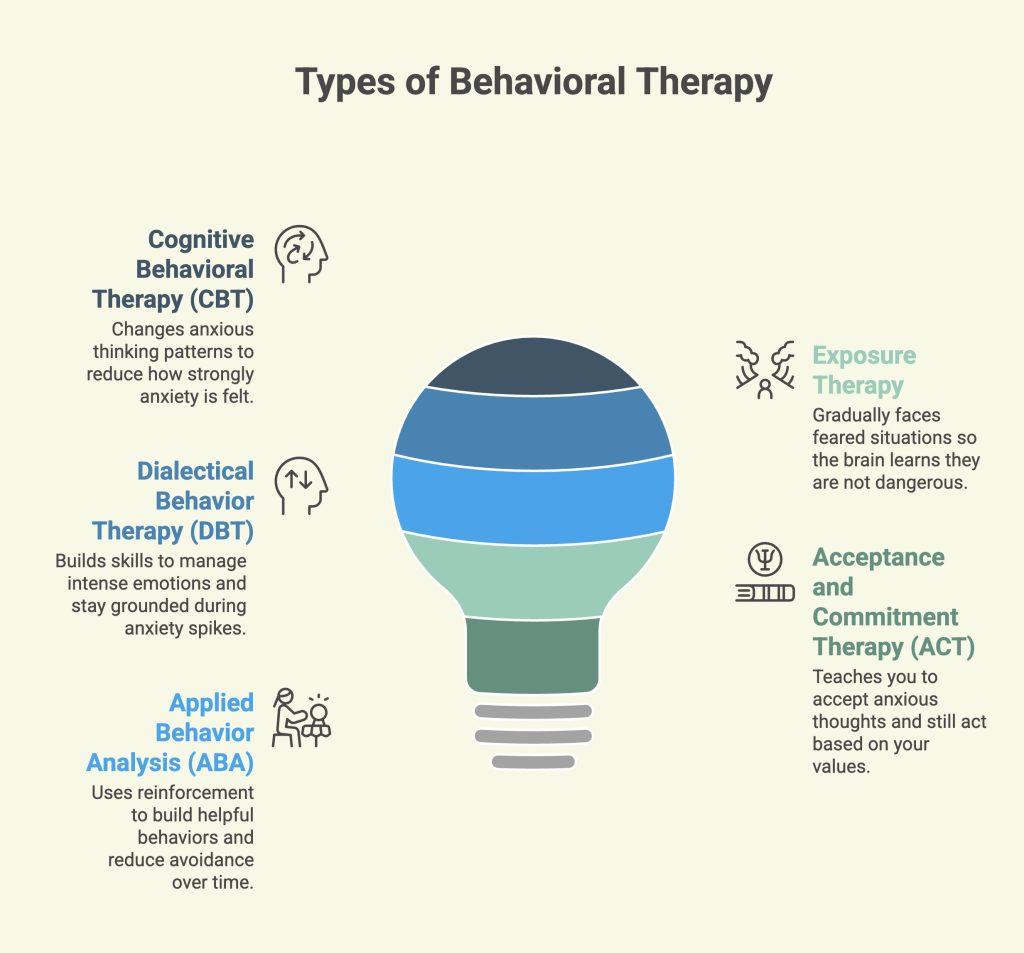
Behavioral therapy for anxiety uses structured approaches such as Cognitive Behavioral Therapy (CBT), Exposure Therapy, Dialectical Behavior Therapy (DBT), Acceptance and Commitment Therapy (ACT), and Applied Behavior Analysis (ABA), each targeting patterns that drive anxiety.
Cognitive behavioral therapy (CBT)
CBT for anxiety helps you notice patterns in your thinking that increase it, such as assuming the worst or overthinking situations. You learn how to question these thoughts and replace them with more realistic ones, which reduces how strongly anxiety shows up.
Exposure therapy
Exposure therapy works by gradually facing situations you usually avoid because of anxiety. By doing this in a safe and controlled way, your brain learns that these situations are not as dangerous as they feel, which reduces fear over time.
Dialectical behavior therapy (DBT)
DBT focuses on managing strong emotions that can make anxiety feel overwhelming. It teaches skills to calm your body, tolerate distress, and stay grounded when emotions spike.
Acceptance and commitment therapy (ACT)
ACT teaches you how to stop fighting anxious thoughts and instead focus on how you respond to them. You learn to take action based on your values, even when anxiety is present.
Applied Behavior Analysis (ABA)
ABA focuses on changing behaviors by reinforcing helpful actions and reducing unhelpful ones. In anxiety treatment, it is used in structured settings to build positive habits and reduce avoidance patterns.
How does behavioral therapy for anxiety work?

Behavioral therapy for anxiety works by breaking the cycle between fear, avoidance, and reinforcement. It directly targets the behaviors that keep anxiety active rather than only discussing the symptoms.
The process starts with identifying triggers and avoidance patterns. From there, therapy introduces graded exposure, where feared situations are ranked from least to most distressing and approached step by step.
Someone with panic symptoms may start by recreating mild physical sensations, then gradually face real-world triggers. This method reduces sensitivity to those sensations with repeated exposure.
Cognitive restructuring is often included, helping individuals challenge unrealistic thoughts such as catastrophizing. Instead of assuming the worst outcome, patients learn to evaluate evidence and develop more balanced responses.
Another component is behavioral activation, which encourages re-engagement in activities that anxiety has limited. This improves mood and reduces withdrawal patterns.
Most progress happens between sessions through structured exercises. These may include practicing exposure tasks, tracking thoughts, or applying coping strategies in daily situations.
Benefits of behavioral therapy for anxiety

Behavioral therapy provides measurable and lasting improvements in how anxiety affects daily life by focusing on skills that support long-term change rather than temporary relief.
Reduces anxiety symptoms
Behavioral therapy lowers anxiety severity by changing how thoughts and behaviors interact. Research shows that Cognitive Behavioral Therapy is effective in reducing anxiety symptoms across multiple anxiety disorders.
Reduces avoidance patterns
Therapy helps individuals face situations they previously avoided. This weakens the fear response and increases confidence in handling triggers.
Builds practical coping skills
Behavioral therapy teaches skills such as relaxation techniques, thought restructuring, and problem-solving. These can be applied independently in everyday situations.
Supports long-term improvement
Because individuals learn how to manage anxiety directly, improvements continue even after therapy ends without relying on ongoing treatment.
Offers flexible treatment options
Behavioral therapy can be delivered through individual sessions, group settings, or telehealth, making it accessible across different needs and schedules.
Who is a good fit?

Behavioral therapy is a good fit for individuals who are ready to actively work on changing patterns that contribute to anxiety through structured, skill-based treatment.
You may benefit from behavioral therapy if you:
- Have anxiety-related conditions: You experience generalized anxiety, panic disorder, social anxiety, or specific phobias, including physical symptoms like a rapid heart rate or muscle tension.
- Actively participate in treatment: You engage during sessions and are willing to practice techniques consistently outside of them.
- Are willing to practice skills: You can complete structured exercises between sessions, such as exposure tasks or thought tracking.
- Notice patterns of avoidance: You avoid situations, conversations, or responsibilities due to anxiety and want to change these patterns.
- May need additional support first: You are not in immediate crisis and are open to an active, skill-based approach to treatment.
Getting control over anxiety with Sommer Psychology Group
Behavioral therapy focuses on helping you understand your anxiety, reduce its impact, and change the patterns that keep it active. Through structured, evidence-based approaches, you build practical skills that support long-term stability.
Care is personalized to your needs and designed to help you apply these tools in real-life situations, not just during sessions.
If this approach feels right for you, get a free consultation and speak with experienced clinicians who specialize in anxiety disorders.
Frequently asked questions
How effective is behavioral therapy for anxiety?
Behavioral therapy reduces anxiety symptoms in most patients, with about 75% reporting measurable improvement. Results depend on consistency, with structured practice and exposure exercises driving stronger long-term outcomes than passive or irregular participation.
How long does behavioral therapy take to work?
Most people start noticing changes within 5 to 20 sessions when they actively practice the techniques. Progress will still differ based on symptom severity, level of effort, and how consistently skills are used outside of sessions.
Can behavioral therapy work without medication?
Yes, behavioral therapy can effectively reduce anxiety without medication for many individuals. It builds coping skills that directly change behavior patterns, though some cases benefit from combining therapy with medication for faster or more stable symptom control.
What happens if you stop behavioral therapy early?
Stopping early can limit long-term progress because key skills may not fully develop. Anxiety patterns return if exposure and practice are incomplete, since lasting change depends on repetition and applying strategies consistently over time.
Is behavioral therapy a long-term solution for anxiety?
Yes, behavioral therapy supports long-term change by building skills that remain useful after treatment ends. It helps reduce reliance on short-term fixes and improves how anxiety is managed over time.