
Overanalyzing slows down when you learn to notice thought loops and shift your response in the moment. Instead of trying to solve every possibility, the focus becomes learning how to step out of the pattern and return to what is actually happening.
You may notice this pattern through repeated thinking, doubt around small choices, or difficulty letting things go. Is it possible to shift this? Yes, especially when it begins to affect your focus, confidence, or ability to move forward.
Below, we’ll break down practical, evidence-based ways to stop overanalyzing, including how to manage it in the moment and how to build more stable thinking patterns over time.
Why do people overanalyze?

People overanalyze because the brain is trying to prevent mistakes, rejection, or negative outcomes. Thinking things through feels like a way to stay in control.
The problem is that the brain starts treating normal situations as high risk. A simple message or conversation can feel important enough to replay, even when nothing is wrong.
This pattern often develops from anxiety, perfectionism, or past experiences where things felt uncomfortable or unpredictable. The brain learns to double-check to avoid that feeling again.
Overanalyzing shows up as mental loops, such as replaying conversations, imagining outcomes, or trying to read what others are thinking. Certain thinking patterns, like expecting the worst or assuming something went wrong, keep the cycle going.
Situations people typically overthink

Overanalyzing tends to show up in situations where the outcome feels uncertain or where you feel evaluated by others. These moments often trigger repeated thinking loops that are hard to shut off:
- Social interactions: You replay conversations, question what you said, or wonder how others interpreted your words. This can make future interactions feel more stressful.
- Major decisions: Choices like career moves, relationships, or finances can lead to overthinking every possible outcome, making it harder to take action.
- Future scenarios: You mentally run through worst-case situations to feel prepared, but this usually increases anxiety instead of resolving it.
- Daily decisions: Even small choices, like replying to a message or planning your day, can take longer because of the fear of making the wrong decision.
Tips for overcoming overthinking
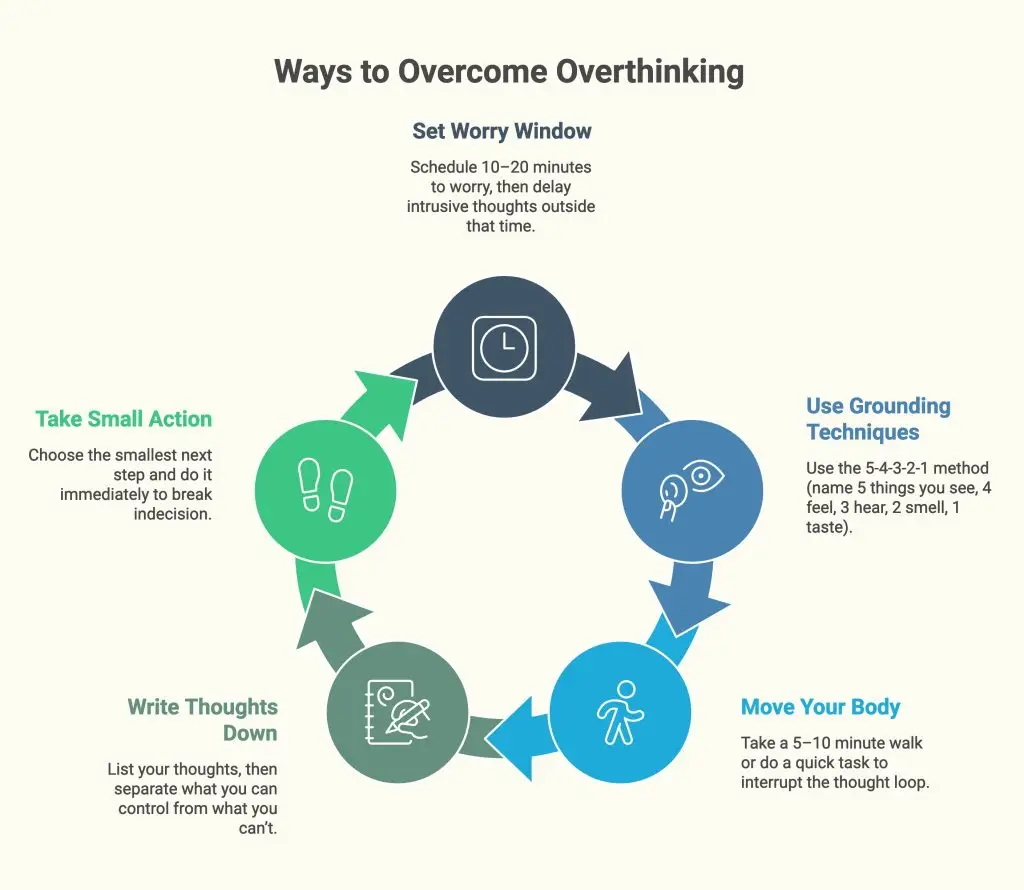
Stopping overanalyzing involves interrupting repetitive thought loops and shifting attention toward structured, action-based strategies.
These techniques focus on practical ways to regain control in real time and support more stable thinking patterns.
Set a defined worry window
A defined worry window limits overthinking by containing it within a specific timeframe, usually 10 to 30 minutes. This trains the brain to delay intrusive thoughts instead of engaging with them throughout the day.
Use grounding techniques to reset focus
Grounding techniques reduce overthinking by shifting attention back to the present through sensory input. The 5-4-3-2-1 method engages the senses and can lower anxiety within minutes.
Move your body to break the loop
Physical movement interrupts overthinking by redirecting focus away from internal thoughts. Walking for a few minutes or completing simple tasks can help reset attention and reduce mental repetition.
Write thoughts down to reduce mental load
Writing thoughts down reduces overthinking by moving them out of working memory. This lowers the need to mentally repeat concerns and helps organize what feels overwhelming.
Take small action to regain control
Taking small action reduces overthinking by replacing analysis with forward movement. Even one step helps break indecision and supports more effective decision-making.
When overthinking affects your ability to socialize

Overthinking pulls attention inward, making it harder to stay present during conversations. Instead of listening, your focus shifts to how you sound, what you said, or what the other person might be thinking.
This can make conversations feel forced and harder to follow. You may miss cues, lose your train of thought, or feel disconnected in the moment.
Afterward, the mind keeps going. Replaying interactions and questioning small details can reinforce doubt and make future social situations feel more stressful.
In some cases, this leads to avoidance. When interactions start to feel draining or uncomfortable, pulling back can feel easier, which slowly reduces confidence and limits connection.
When Therapy Can Be Helpful

Therapy can be helpful when overthinking continues despite efforts to manage it on your own and starts to feel repetitive or difficult to interrupt.
It is most effective when patterns like overanalyzing, second-guessing, or mental replay keep showing up in the same situations. At this point, insight alone is not enough to change the pattern.
Therapy gives you a structured way to identify what is driving these patterns and apply techniques that change how you respond in the moment. This helps you move out of repetitive thinking and into more direct, effective action.
It is also useful when you want a clear, consistent approach instead of relying on trial and error, which does not hold up across different situations.
Types of therapies that help overthinking

Effective therapies for overthinking are Cognitive Behavioral Therapy, Acceptance and Commitment Therapy, Metacognitive Therapy, mindfulness-based approaches, and exposure-based methods, each addressing different aspects of thought patterns and responses.
Cognitive behavioral therapy (CBT)
CBT reduces overthinking by identifying and changing negative thought patterns that drive repetitive thinking. It teaches practical skills to challenge and replace unhelpful thoughts.
Acceptance and commitment therapy (ACT)
ACT reduces overthinking by helping individuals accept thoughts without reacting to them. This lowers the urge to engage with every thought.
Metacognitive therapy (MCT)
Metacognitive Therapy reduces overthinking by changing how individuals relate to their thoughts, helping reduce time spent in rumination.
Mindfulness-based approaches
Mindfulness-based approaches reduce overthinking by training attention to stay in the present, which limits both past-focused rumination and future-focused worry.
Exposure-based methods
Exposure-based methods reduce overthinking by addressing avoidance behaviors and helping individuals face situations that trigger repetitive thinking.
Work with an anxiety disorder therapist today
Moving from constant thinking to clear action is central to learning how to stop overanalyzing, which involves changing how you respond to thoughts rather than trying to eliminate them. With consistent practice, thoughts feel less urgent, and the need to analyze every detail begins to decrease.
As this shift develops, mental loops become less frequent, and decisions become more direct. Each time you interrupt overthinking and take action, you strengthen patterns that support clarity and focus. Get a free consultation to apply these strategies with structured, practical support.
Frequently asked questions
What causes overanalyzing?
Overanalyzing is often driven by a need to prevent mistakes or negative outcomes. It is commonly linked to anxiety, perfectionism, or past experiences that make uncertainty feel harder to tolerate.
What is the biggest problem for overthinkers?
The biggest problem is getting stuck in mental loops that delay decisions and reduce action. This can lead to missed opportunities, increased stress, and difficulty following through on everyday tasks.
How can therapy help with overanalyzing?
Therapy helps by identifying patterns that keep overthinking active and teaching ways to interrupt them. It provides structured techniques to shift from repetitive thinking into more effective responses.
How do you stop overanalyzing in the moment?
Stopping overanalyzing in the moment involves redirecting attention through grounding or immediate action. Simple steps like focusing on your surroundings or completing a small task can break the thinking cycle.
Can overanalyzing go away completely?
Overanalyzing does not need to disappear to become manageable. With the right strategies, it becomes less frequent, less intense, and easier to control in daily situations.